
Recently, NASA’s astronaut Donald Pettit shared a video taken onboard the International Space Station (ISS). Described as “Cosmic Fireflies”, the clip shows a view from the ISS where dozens of SpaceX’s Starlink satellites can be seen appearing and then suddenly disappearing as they move to reflect the Sunlight in their orbit above the nightside of the Earth, resembling fireflies’ dance among the woods in dark. However, while the sight created by these satellites may be astonishing and metaphorically beautiful to the eyes, what it does not show are the hazards and challenges that come with an increasing number of satellites in the sky – space pollution.
Satellite Constellation and what are the impacts of growing satellites number in the sky?
Starlink is a satellite constellation project developed by the American private space technology company SpaceX, aiming to provide high-speed broadband internet through a network of satellites in low-Earth orbit. According to Jonathan’s Space Report, as of the 12th of December 2024, there are 6865 Starlink satellites in orbit, providing internet coverage to more than 100 countries and territories.
With many more constellation projects planned by other private companies and government agencies, it is estimated that by 2030, the number of satellites in the sky will surpass 100,000. Of course, it is without doubt that from a technological perspective, projects like this are going to benefit our day-to-day lives, e.g., better communication connectivity, weather predictions, etc. However, the rapid growth of satellites in orbit is inevitably posing threats and increasing risks that urgently need to be addressed before it is too late.
Intuitively, space junk is the first issue that comes to mind for many when thinking about space pollution. While it is a crisis in its own right without question, I would like to highlight a couple of less-talked-about but equally serious issues resulting from space pollution: Impact on astronomy research and cultural significance of the dark sky.
Impact on Astronomy Research
Observational astronomy relies heavily on clear and dark skies for obtaining high-quality data, especially when it comes to observing very dim objects. According to a study conducted by the European Southern Observatory (ESO) on the effect of 18 satellite constellations (i.e., 26,000 satellites in low-orbit) on astronomical observations in the visible and infrared regime, spectrographs and imaging using ground-based telescopes are expected to be affected, particularly during the beginning and end of the night, where up to few percentages of the total exposures taken would be ruined. The effect is even more prominent for very wide-field imaging observations on large telescopes (e.g., Vera Rubin Observatory), for which 30 to 40% of the exposure could be ruined at the beginning and end of the night.
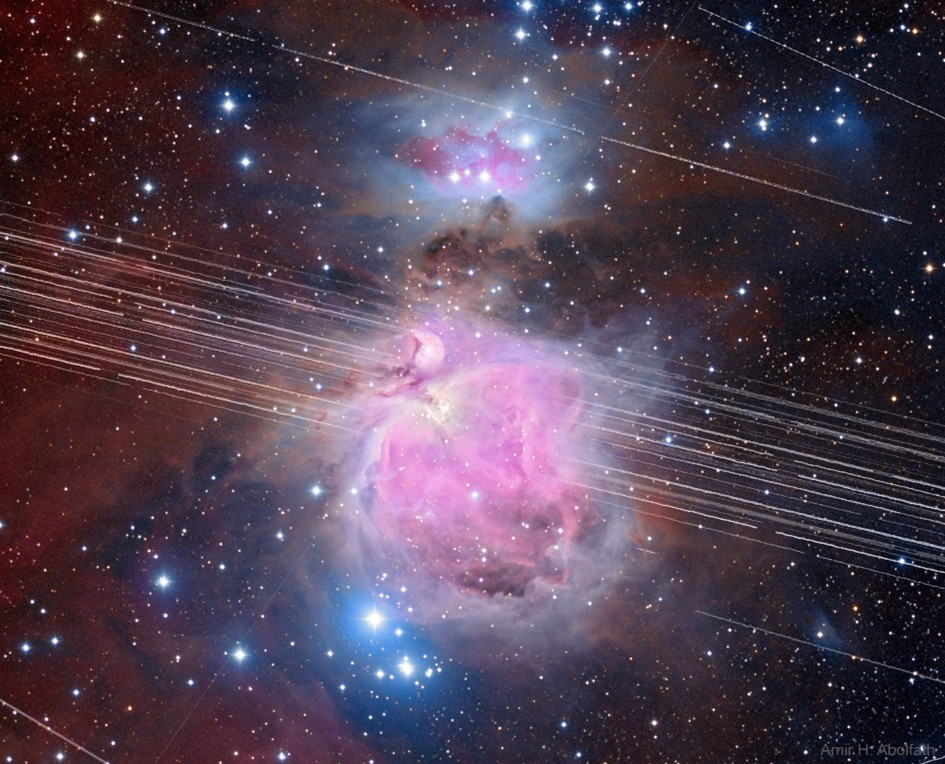
I found a perspective raised by a Nature Astronomy paper particularly interesting. The text reads: “It is an additional irony that astronomy—whose many institutions and facilities were built on the traditional lands of Indigenous peoples— is itself now threatened by the colonization of space by the satellite industry”. I think it is not merely a cool fact that the field of astronomy is now experiencing the consequences of the satellite industry in a way that mirrors how the field has historically impacted Indigenous communities in its pursuit of knowledge. Rather, on a bigger picture, it is a lesson trying to warn us that we should have a mindset that keeps us aware of what is the cost behind any pursuit and what can we do more along the way to reach that goal.
Cultural significance of the dark sky
The increasingly urbanised population is a trend we see in all countries around the world. For reference, in 1900 only 10% of the world’s population lived in cities. Today, that statistic is over 50% and is expected to be 75% by 2050. While larger cities are often associated with greater opportunity and higher efficiency in just about every aspect of life, cities also “caged” their inhabitants, disconnecting them from nature through fast-paced lifestyles and urban noise and pollution – depriving them of the right to have time and look up to appreciate a sky full of stars.
In the autumn of 2022, during the 2nd year of my master’s study, I conducted an observational project on the island of La Palma in the Canary Islands, where I had the opportunity to personally operate The Mercator Telescope and collect data. I still clearly remember that first night on top of the mountain when I witnessed the night sky for the first time. It was a sky so dark yet so brightly lit up by all the stars it fell under. It was a sight that made you forget to breathe and an intense emotion you only felt when appreciating something from the bottom of your heart.
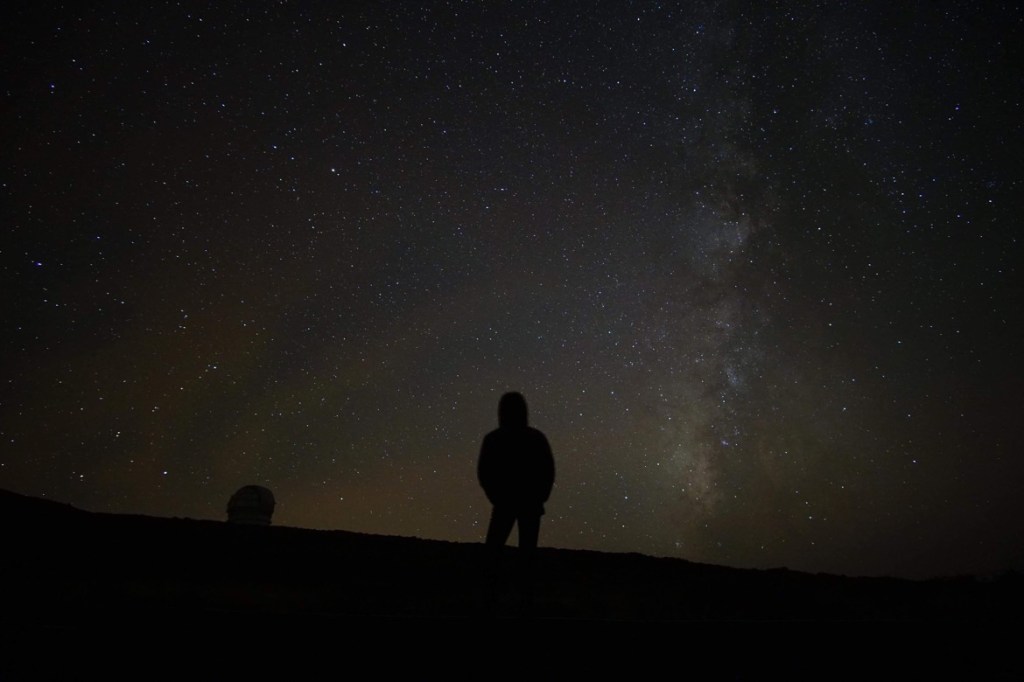
After spending five nights on the mountain during my research trip, I felt deeply inspired and reminded of why the universe is so endlessly charming. I also began to wonder if our ancestor shared similar thoughts as they gazed at the night sky – a sky that, to them, was just a normal and ordinary part of their everyday world. There is no direct historical account of what our primitive ancestors made of a dark sky, it might simply be a sign of the passing of another day and the start of evening rest. That being said, dark sky does have a cultural significance in the development of human civilisation. In fact, culturally, the dark sky has inspired countless myths, works of art, literature and music across cultures worldwide, and that is not to mention the historical role it also played in helping travellers navigate and farmers track seasons.
The dark sky, therefore, is not just an inspiration for humans on Earth but it is also a testament to who we are and why humanity is the way it is today. For these reasons, I believe that we need a renewed mindset: rather than treating the preservation of the dark sky solely as an environmental concern, we should strive to protect its dark appearance because it is a universal cultural heritage that connects us all.
 Jimmy Shih